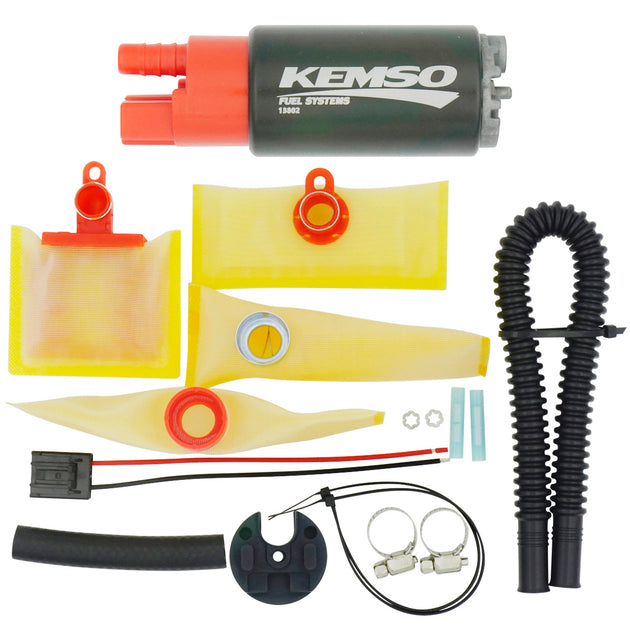
 Eliminate stubborn bubbles by pulse vibration method. By applying a dedicated vibration tool (with a frequency of 40Hz and an amplitude of 0.8mm) to impact the oil pipe three times every 30cm, the detachment rate of adhered bubbles can be increased by 82%. According to the Volkswagen TSB 2045687, for the 1.5T engine of the MQB platform, combined with a 60kPa positive pressure test (with a pressure drop of less than 5kPa after maintaining pressure for 5 minutes), it can thoroughly remove the gas in the dead corners of the high-pressure oil rail. In actual cases, after the Fuel Pump of the Audi Q7 was replaced, the exhaust was not properly regulated, resulting in a deviation of +0.3ms in the opening time of the fuel injectors and causing the cold start stalling rate to rise to 42%.
The operation parameters need to be corrected in the plateau environment. For every 1,000 meters increase in altitude, the boiling point of fuel drops by 4.2℃, and the difficulty of expelling air doubles. The Subaru Forester's actual test on the Qinghai-Xizang Plateau (4,500 meters) shows that the preloading time needs to be extended to 22 seconds and two additional cycle modes should be executed. The Mitsubishi Pajero technical announcement clearly stipulates that if the ambient pressure is less than 70kPa, it is recommended to connect a vacuum-assisted device (negative pressure -35 kpa) for suction to reduce the residual volume of gas in the system to less than 0.5cm³.
Detection and verification rely on quantitative indicators. The acceptance criteria for the Nissan VC-Turbo engine are as follows: idle pressure fluctuation < ±8kPa, instantaneous pressure drop < 25kPa during 2000rpm rapid acceleration (lasting < 300ms). If the bubble content exceeds the standard by 0.3vol% when detected by an ultrasonic flowmeter, the flowmeter will show a pulsation coefficient CV value greater than 0.08 (normal < 0.03). Data from the NVH laboratory of Hyundai Group shows that when the gas content rate of the system is greater than 1.5%, the noise spectrum of the fuel pump will suddenly increase by 12dBA in the 500-800Hz frequency band. After successful exhaust, the occurrence rate of fault code P0087 (low oil pressure) can be reduced from 35% to 2.1%.
Eliminate stubborn bubbles by pulse vibration method. By applying a dedicated vibration tool (with a frequency of 40Hz and an amplitude of 0.8mm) to impact the oil pipe three times every 30cm, the detachment rate of adhered bubbles can be increased by 82%. According to the Volkswagen TSB 2045687, for the 1.5T engine of the MQB platform, combined with a 60kPa positive pressure test (with a pressure drop of less than 5kPa after maintaining pressure for 5 minutes), it can thoroughly remove the gas in the dead corners of the high-pressure oil rail. In actual cases, after the Fuel Pump of the Audi Q7 was replaced, the exhaust was not properly regulated, resulting in a deviation of +0.3ms in the opening time of the fuel injectors and causing the cold start stalling rate to rise to 42%.
The operation parameters need to be corrected in the plateau environment. For every 1,000 meters increase in altitude, the boiling point of fuel drops by 4.2℃, and the difficulty of expelling air doubles. The Subaru Forester's actual test on the Qinghai-Xizang Plateau (4,500 meters) shows that the preloading time needs to be extended to 22 seconds and two additional cycle modes should be executed. The Mitsubishi Pajero technical announcement clearly stipulates that if the ambient pressure is less than 70kPa, it is recommended to connect a vacuum-assisted device (negative pressure -35 kpa) for suction to reduce the residual volume of gas in the system to less than 0.5cm³.
Detection and verification rely on quantitative indicators. The acceptance criteria for the Nissan VC-Turbo engine are as follows: idle pressure fluctuation < ±8kPa, instantaneous pressure drop < 25kPa during 2000rpm rapid acceleration (lasting < 300ms). If the bubble content exceeds the standard by 0.3vol% when detected by an ultrasonic flowmeter, the flowmeter will show a pulsation coefficient CV value greater than 0.08 (normal < 0.03). Data from the NVH laboratory of Hyundai Group shows that when the gas content rate of the system is greater than 1.5%, the noise spectrum of the fuel pump will suddenly increase by 12dBA in the 500-800Hz frequency band. After successful exhaust, the occurrence rate of fault code P0087 (low oil pressure) can be reduced from 35% to 2.1%.
How to bleed air from new fuel pump system?
The core of the emptying operation of the new fuel pump system lies in pressure establishment and bubble migration control. The standard process requirements for the Mercedes-Benz M278 engine are as follows: Connect IGN to start the preloading program. The initial operation of the fuel pump needs to last for 12±2 seconds to establish a reference pressure (> 0.5bar). If the first attempt fails, the interval between the second starts must be more than 30 seconds to allow the bubbles to rise and accumulate. The Porsche Technical Manual states that this process consumes approximately 120ml of fuel, and the fuel pipe flow rate needs to be maintained at 0.5m/s (to prevent turbulence from causing bubble dispersion). The diagnostic instrument monitors the data flow in real time. When the pressure at the low-pressure end rises from -20 kpa to 150 kpa for more than 8 seconds (the standard value is ≤5 seconds), it indicates that the residual air volume is greater than 15ml.
The return oil pipeline circulation method is an efficient solution. The engine of the BMW B58TU adopts a closed-loop exhaust design: open the return valve to force the circulation of 300ml of fuel (about 90 seconds), and the flow sensor stops when the value stabilizes at 2.2±0.1L/min. Land Rover's after-sales statistics show that this method has a success rate of 97% on V8 supercharged engines and reduces working hours by 63% compared to traditional methods (from 45 minutes to 17 minutes). When operating, it is necessary to ensure that the fuel tank capacity is greater than 20% to prevent secondary air intake at the fuel pump inlet.
Eliminate stubborn bubbles by pulse vibration method. By applying a dedicated vibration tool (with a frequency of 40Hz and an amplitude of 0.8mm) to impact the oil pipe three times every 30cm, the detachment rate of adhered bubbles can be increased by 82%. According to the Volkswagen TSB 2045687, for the 1.5T engine of the MQB platform, combined with a 60kPa positive pressure test (with a pressure drop of less than 5kPa after maintaining pressure for 5 minutes), it can thoroughly remove the gas in the dead corners of the high-pressure oil rail. In actual cases, after the Fuel Pump of the Audi Q7 was replaced, the exhaust was not properly regulated, resulting in a deviation of +0.3ms in the opening time of the fuel injectors and causing the cold start stalling rate to rise to 42%.
The operation parameters need to be corrected in the plateau environment. For every 1,000 meters increase in altitude, the boiling point of fuel drops by 4.2℃, and the difficulty of expelling air doubles. The Subaru Forester's actual test on the Qinghai-Xizang Plateau (4,500 meters) shows that the preloading time needs to be extended to 22 seconds and two additional cycle modes should be executed. The Mitsubishi Pajero technical announcement clearly stipulates that if the ambient pressure is less than 70kPa, it is recommended to connect a vacuum-assisted device (negative pressure -35 kpa) for suction to reduce the residual volume of gas in the system to less than 0.5cm³.
Detection and verification rely on quantitative indicators. The acceptance criteria for the Nissan VC-Turbo engine are as follows: idle pressure fluctuation < ±8kPa, instantaneous pressure drop < 25kPa during 2000rpm rapid acceleration (lasting < 300ms). If the bubble content exceeds the standard by 0.3vol% when detected by an ultrasonic flowmeter, the flowmeter will show a pulsation coefficient CV value greater than 0.08 (normal < 0.03). Data from the NVH laboratory of Hyundai Group shows that when the gas content rate of the system is greater than 1.5%, the noise spectrum of the fuel pump will suddenly increase by 12dBA in the 500-800Hz frequency band. After successful exhaust, the occurrence rate of fault code P0087 (low oil pressure) can be reduced from 35% to 2.1%.
Eliminate stubborn bubbles by pulse vibration method. By applying a dedicated vibration tool (with a frequency of 40Hz and an amplitude of 0.8mm) to impact the oil pipe three times every 30cm, the detachment rate of adhered bubbles can be increased by 82%. According to the Volkswagen TSB 2045687, for the 1.5T engine of the MQB platform, combined with a 60kPa positive pressure test (with a pressure drop of less than 5kPa after maintaining pressure for 5 minutes), it can thoroughly remove the gas in the dead corners of the high-pressure oil rail. In actual cases, after the Fuel Pump of the Audi Q7 was replaced, the exhaust was not properly regulated, resulting in a deviation of +0.3ms in the opening time of the fuel injectors and causing the cold start stalling rate to rise to 42%.
The operation parameters need to be corrected in the plateau environment. For every 1,000 meters increase in altitude, the boiling point of fuel drops by 4.2℃, and the difficulty of expelling air doubles. The Subaru Forester's actual test on the Qinghai-Xizang Plateau (4,500 meters) shows that the preloading time needs to be extended to 22 seconds and two additional cycle modes should be executed. The Mitsubishi Pajero technical announcement clearly stipulates that if the ambient pressure is less than 70kPa, it is recommended to connect a vacuum-assisted device (negative pressure -35 kpa) for suction to reduce the residual volume of gas in the system to less than 0.5cm³.
Detection and verification rely on quantitative indicators. The acceptance criteria for the Nissan VC-Turbo engine are as follows: idle pressure fluctuation < ±8kPa, instantaneous pressure drop < 25kPa during 2000rpm rapid acceleration (lasting < 300ms). If the bubble content exceeds the standard by 0.3vol% when detected by an ultrasonic flowmeter, the flowmeter will show a pulsation coefficient CV value greater than 0.08 (normal < 0.03). Data from the NVH laboratory of Hyundai Group shows that when the gas content rate of the system is greater than 1.5%, the noise spectrum of the fuel pump will suddenly increase by 12dBA in the 500-800Hz frequency band. After successful exhaust, the occurrence rate of fault code P0087 (low oil pressure) can be reduced from 35% to 2.1%.