Price is the worst first filter in a fragrance supplier search, because it eliminates factories that could have done the work and keeps the ones most likely to cut corners later. The order that works is category fit, then documentation, then sampling, then commercials. Running the filters in that sequence costs nothing extra and removes most of the rework that makes a first production run expensive.
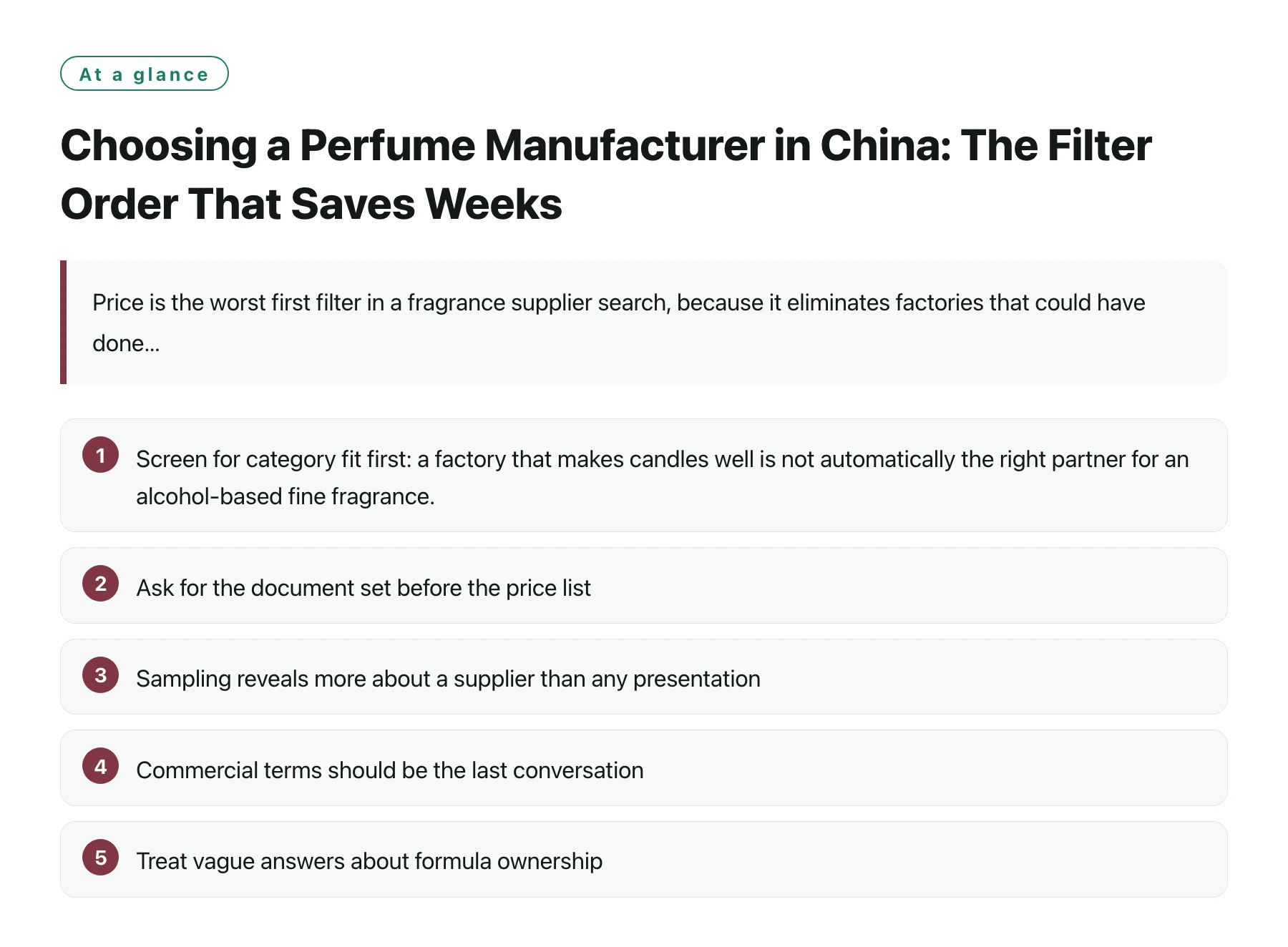
Key takeawaysScreen for category fit first: a factory that makes candles well is not automatically the right partner for an alcohol-based fine fragrance. · Ask for the document set before the price list, because the documents take longer to fake and tell you what the price is actually buying. · Sampling reveals more about a supplier than any presentation, provided you test two candidates with the same brief. · Commercial terms should be the last conversation, since lead time, minimum order and tooling only become comparable once the technical fit is settled. · Treat vague answers about formula ownership, subcontracted processes and change control as disqualifying rather than as items to clarify later.
There are thousands of factories in China that will accept a fragrance order, and the hard part is not finding one. It is finding one whose real capabilities match the product you intend to sell, before you have spent sampling budget and calendar time.
Buyers who start with quotations tend to shortlist on unit price and then work backwards, discovering at the sampling stage that the factory specialises in a different category, subcontracts filling, or treats formula ownership as an open question. By then the comparison is no longer apples to apples.
This checklist sets out the order of filters, what to ask at each stage, and the small set of answers that should end a conversation. It is written for a first or second sourcing project rather than for a mature procurement team with an existing supplier panel.
The filter order, and what each stage is really testing
| Stage | What you request | When to stop |
|---|---|---|
| Category fit | Product categories actually manufactured in house, with examples | The factory only makes a neighbouring category and would be learning on your order |
| Documentation | Certificates with scope annexes, one comparable test report, capability statement | Documents cannot be produced, or the scope names a different site or category |
| Development | Two samples against the same written brief, on the same timeline | The factory will not work to a written brief or cannot explain its sampling process |
| Operations | Lead time, minimum order quantity, tooling ownership, subcontracting list | Subcontracted steps are undisclosed, or tooling ownership is left vague |
| Commercials | Quotation with a cost breakdown by component | The price is unexplained, or it moves materially between comparable scenarios |
| Terms | Formula ownership, confidentiality, change-notification obligations | The supplier resists putting ownership and change notification in writing |
Each stage is cheap compared with the one after it, which is the entire argument for the order. A category mismatch discovered in a document review costs an email. The same mismatch discovered after artwork, tooling and a first production run costs the launch window.

What to verify before anyone talks about price
The verification stage is not about distrust. It is about establishing which claims are documented, because documented claims are the ones you can rely on when a project runs into difficulty.
Three questions do most of the work, and each of them has an answer that a serious manufacturer will already have prepared.
Category fit and process ownership
Ask which categories are manufactured on site, and which steps are subcontracted. Fine fragrance, home fragrance and scented body products carry different formulation constraints, different filling considerations and different regulatory expectations.
Then ask which parts of the process happen in house. Compounding, filling, capping, labelling and packing may all be handled differently, and an undisclosed subcontractor in the middle of the chain is a quality variable you cannot see.
Documentation that travels with the goods
Manufacturing certification is a starting point rather than a conclusion. Independent testing and inspection organisations audit cosmetic sites against recognised GMP schemes and issue reports that can support your own market filings [1]. Ask which accredited body audited the site, and request the report as well as the certificate.
Manufacturers such as Xuelei publish their certificate summaries and service scope on request, which is the normal standard of evidence rather than an exceptional one. A supplier that cannot supply the scope annex of its own certificate has given you a preview of how it will handle your specification sheet.
Who owns the formula, and what happens if it changes
Formula ownership is the most commonly deferred question in a first project and the most expensive one to reopen. Agree in writing who owns the developed formula, what the manufacturer may do with it, and what notice you receive if a material in it is restricted or discontinued.
That last point has teeth. Cosmetics rules differ between markets, and requirements around ingredient declarations and product notification vary, so a change in a raw material can ripple into your labelling and your market access [2]. Build an obligation to notify into the agreement while both sides are still friendly.
Five conversations worth having before the first order
- The brief conversationGive two or three shortlisted factories the same written brief and see who asks the better questions before quoting.
- The sampling conversationAgree the number of rounds included, the timeline for each, and how feedback should be given and recorded.
- The change conversationAsk what happens if a raw material is discontinued or a use restriction is revised mid-project, and who pays for the rework.
- The scale conversationAsk how the process changes between a sample batch and the first production run, especially for filling and packing.
- The exit conversationConfirm what you receive if the relationship ends: formula documentation, artwork files, tooling or moulds, and any outstanding stock.
Red flags that only appear after sampling starts
The early stages of a supplier relationship are designed to look smooth, so the most useful signals appear once work has begun and the factory has to make small judgement calls on your behalf.
None of the following patterns is fatal on its own. A cluster of them, appearing in the same project, is a reliable indication that the supplier is not equipped for the order you are placing.
Substituted materials without notice
If a sample smells different from the approved reference and no one volunteered the reason, ask for the material list by version. Silent substitution is the classic sign that a supplier treats the formula as an internal matter rather than as your asset.
Timelines that move without an explanation
Slippage happens in every factory. The informative part is whether the factory tells you before the deadline or after you ask, and whether the revised date comes with a reason. Repeated undisclosed slippage is a planning failure, not bad luck.
Specifications that exist only in email
The specification sheet, the approved sample reference and the packaged batch should all refer to one controlled version. If the only record of what was approved is a thread of messages, you have no basis for a claim later.
This is also where the cost of a cheap first order becomes visible. The cheapest quotation is not the cheapest project once rework, re-sampling and a slipped launch are included.
Write down your filter order before you contact anyone, and keep it in front of you during the first call. The reason is not discipline for its own sake: a factory that leads with an attractive price will pull the conversation toward commercials, and once you are comparing numbers it becomes very hard to go back and ask who owns the formula. Give yourself permission to say that pricing comes after sampling. The suppliers worth keeping will not object to that sequence, because it is the sequence they would prefer anyway.
Sources
- SGS: Cosmetics, Personal Care & Household Testing —— Testing, inspection and certification services for cosmetics and personal care, including microbiological, stability and safety testing aligned with cosmetics GMP.
- European Commission: Cosmetics in the EU —— The European Commission's overview of EU cosmetics rules, including the responsible person, product information file and safety report requirements.
Frequently asked questions
Should I choose a supplier purely on the lowest quotation?
Not as a first filter. A lower quotation usually reflects either a simpler formula, a lower grade of material, or steps that are subcontracted somewhere you cannot see. Compare quotes only after the technical scope is identical, then ask each supplier to explain what drives the difference.
How many factories should I shortlist?
Two or three is usually enough to compare properly. More than that spreads your sampling budget thin and slows decisions. Give every shortlisted factory the same brief, the same timeline and the same evaluation method so the comparison means something.
What documents should I ask for first?
Start with certificates plus their scope annexes, one third-party test report for a comparable product, and a written capability statement covering which processes are in house. These arrive faster than samples and eliminate unsuitable suppliers before you spend on development.
Can a Chinese manufacturer produce for the European market?
Yes, provided the product and its documentation meet the rules of the market where it is sold. Responsibility for compliance usually sits with an entity established in that market, so confirm early which party holds that role and what documentation the manufacturer will supply to support it.
How do I protect my formula if the manufacturer develops it?
Put ownership in the contract before development starts. Specify who owns the formula and its documentation, what the manufacturer may do with it, how confidentiality is maintained, and what you receive if the relationship ends. Discussing this at the start is normal practice rather than a sign of distrust.