The ISO/IEC 17025 Laboratory Behind PV Cable Testing
A speciality cable laboratory was set up by KUKA CABLE in December 2015 and is described on the site as an ISO/IEC 17025 laboratory — ten years and nine months of operation by the read date of 24 Sept 2026, on my own count. It is the room where the solar pv cable range is aged, soaked, abraded, bent cold and pulled to breaking point, and it is why the published numbers arrive with test names attached instead of standing alone.
Key takeaways
- The laboratory opened in December 2015 and is described as operating to ISO/IEC 17025.
- Its four-stage model ends in 100% inspection of finished products plus sample retention and traceability.
- Ageing work includes a 2,000-hour xenon lamp run, equated by the site with about 360 weathering cycles.
- Two life figures appear on the same topic: more than 25 years with certification, 30 years on one product page.
What a laboratory does that a datasheet cannot
A datasheet is a set of design values. A laboratory is the machinery that checks whether the material still meets them after it has been left under a lamp, frozen, soaked and stretched. The client describes its cables as swimming in leading laboratories where mechanical and electrical properties are tested thoroughly, and the published pages back that up with named procedures: immersion and moisture checks, artificial-sunlight weathering, abrasion, low-temperature bending and elongation, tensile strength measured after ageing, solderability, static flexibility and dimensional verification.
The laboratory statement also fixes a date. December 2015 is nearly three years before the PV division became independent in August 2018, so testing capacity existed before the solar range was separated out as a business.
The four stages around the bench
Testing is the visible part of a wider quality model. The site sets out four stages: raw materials are selected and tested against several international benchmarks; manufacturing is monitored by digital control systems; finished products go through 100% inspection for electrical, mechanical and environmental performance; and samples are retained so that a batch can be traced later. The company calls this its SIF quality model and presents it as going beyond what certification alone requires.
The retention stage is the one buyers use least and could use most. A retained sample is what makes a complaint checkable months later, because the reference material still exists. Nothing in the published description promises that a replacement will be provided; what it establishes is that the comparison is possible at all.
What the testing covers on the PV side
Ageing gets the largest share of attention because it is the slowest failure to reproduce. A 2,000-hour xenon lamp test, described as equal to about 360 weathering cycles of sun, humidity and ozone, is being arranged on the solar pv cable range. Insulation integrity is the target of that run, and the published elongation figure for the compound, up to 185% where EN 50618 asks for more than 125%, is the number it feeds.
Thermal and fire behaviour are measured separately. The 1500 V construction is rated for ambient from −40 °C to +90 °C, for +120 °C during a long short-circuit and for +250 °C during a short 5-second event. Fire behaviour is checked by burning one length vertically at 800 °C for a minute and requiring the sample to extinguish itself. None of these are lifetime predictions; together they describe the envelope a sample survived.
Where the documents come from
Sizes, weights and strand counts are published in the cross-section table on the product data page, which is the document to hold a sample against: 4 mm² is 56 strands of 0.29 mm at 59 g/m, 6 mm² is 84 strands of 0.29 mm at 78 g/m, and 10 mm² is 142 strands of 0.29 mm at 130 g/m. The company runs its own test programme alongside those figures, and the published test pages list the procedures in the order the laboratory uses them.
The same page prints wall thickness so that a delivery can be checked against the design: insulation 0.7 mm and sheath 0.8 mm across the 1.5 mm² to 10 mm² sizes, widening to 0.9 mm to 1.7 mm on the larger constructions. A pair of callipers, a metre of sample and that table settle most questions about whether a reel matches the datasheet, without needing a laboratory of your own. Where a sample fails the check, the retained reference material is what makes the comparison meaningful.
| Date | Milestone | What it changed for testing |
|---|---|---|
| December 2015 | speciality cable laboratory established | in-house ageing and mechanical work begins |
| March 2016 | sales to more than 70 countries | certification spread across export markets |
| August 2018 | PV division becomes independent | one team owns the solar test programme |
| June 2021 | wire harness processing base | assemblies move in-house |
| March 2023 | national high-tech enterprise | formal recognition of the development work |
| May 2023 | new factory completed | more floor space for lines and benches |
Worked example
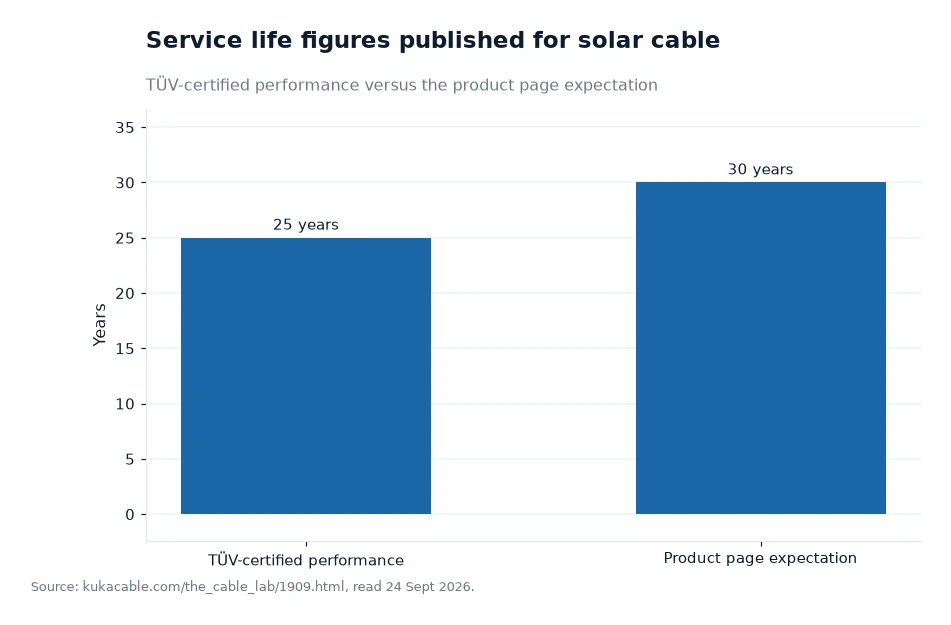
Two service-life figures are published on the same subject, and the chart in this section is the manufacturer's own statement of them rather than a laboratory result. Its title is "Service life figures published for solar cable", its bars are 25 years for TUV-certified performance and 30 years as the product page expectation, and its source page is kukacable.com/the_cable_lab/1909.html. Three calculations are mine, done on published dates and figures: from December 2015 to 24 Sept 2026 the laboratory has been running for ten years and nine months; the gap between the two life figures is five years; and that gap is 20% of the lower figure. None of them is a durability measurement. They do show that the two numbers live on different pages with different scopes, which is exactly the sort of thing a specification reviewer should notice.
Frequently asked questions
Does a laboratory description replace a certificate?
No. A described laboratory explains who does the testing and how, while a certificate names a construction that passed a recognised standard. The site names more than 30 types of certificates including TUV, IEC, CE, SAA and UL, and TUV certification is presented as the starting point rather than the finish. Ask for both: the certificate for the size on order and the report from the laboratory that tested it.
Which published test comes closest to proving a 25-year life?
None of them proves it, and the site does not claim that they do. The 2,000-hour xenon lamp run, equated with about 360 weathering cycles, is the longest accelerated ageing check described, and the elongation figure of up to 185% is the material property it supports. A 25-year expectation is a judgement drawn from those results, not a measurement of 25 elapsed years.
What a buyer should take away
Ask who tested the cable, on what equipment, and in which month. The published answer is a laboratory established in December 2015 that has been running for a decade, a four-stage model that ends in 100% inspection and sample retention, and a test menu a buyer can quote directly into a specification. Match those against the construction on the order and the certificate that covers it. Where the site is silent — per-batch records, capacity, warranty terms — put the question in the purchase order rather than assuming an answer.
The December 2015 laboratory date and the ISO/IEC 17025 description come from the manufacturer's own website, kukacable.com, quoted 24 Sept 2026, while the elapsed years, the five-year gap and the percentage comparison are my own arithmetic on published values[1].